Blockchain Supply Chain Tracking 2026: Real-World Use Cases That Work
In 2026, Blockchain technology for supply chain tracking is no longer experimental. It is a proven operational tool that is saving companies significant costs, reducing fraud, and delivering meaningful transparency to consumers. Walmart, for example, reports it can trace a food shipment from source to store in seconds – a process that previously took days.
This article is for business owners, logistics professionals, and decision-makers who want to explore practical, documented applications of blockchain in supply chains, grounded in real implementations.
Why 2026 Represents a Maturation Point for Blockchain in Supply Chains
The technology has moved well past proof-of-concept. Layer-2 solutions and enterprise-grade chains – including Polygon, Hyperledger Fabric, VeChain, and IBM Food Trust – have substantially reduced transaction costs, making deployment viable for mid-market businesses, not just global enterprises.
Key developments characterising the current landscape:
- Enterprise blockchain adoption has expanded substantially since 2022, with deployment most pronounced in food, pharmaceuticals, luxury goods, and logistics.
- Consumer demand for product provenance has grown, driven by regulatory requirements in the EU and voluntary sustainability commitments from major brands.
- Transaction costs on permissioned and hybrid chains are now low enough that per-item tagging is economically practical at scale.
Seven Documented Examples of Blockchain in Supply Chains
| Industry | Company | Blockchain | What They Track | Outcome |
|---|---|---|---|---|
| Food | Walmart, Carrefour, Nestlé | IBM Food Trust (Hyperledger) | Leafy greens, baby food, coffee | Recall tracing reduced from days to seconds |
| Pharma | Pfizer, Moderna | MediLedger (private chain) | Vaccine cold-chain temperatures | Significant reduction in counterfeit rates on tracked lines |
| Luxury | LVMH | Aura Blockchain Consortium | Handbags, watches | Verified provenance; supports authentication in secondary market |
| Diamonds | De Beers | Tracr (private) | Diamonds above 0.2 carats | Conflict-free certification for auditable chain of custody |
| Automotive | BMW, Ford | MOBI consortium | Batteries and parts | Verified cobalt and minerals sourcing |
| Shipping | Maersk | OriginTrail and carrier-specific systems | Container documentation | Reduction in paperwork-related delays |
| Coffee | JDE Peet’s and partners | Farmer Connect | Bean-to-cup journey | Faster settlement times and improved farmer income transparency |
Note: IBM and Maersk’s joint TradeLens platform was formally discontinued in December 2022, having failed to achieve the industry-wide adoption required for commercial viability. Maersk and other major carriers have since adopted alternative solutions, including OriginTrail and proprietary systems.
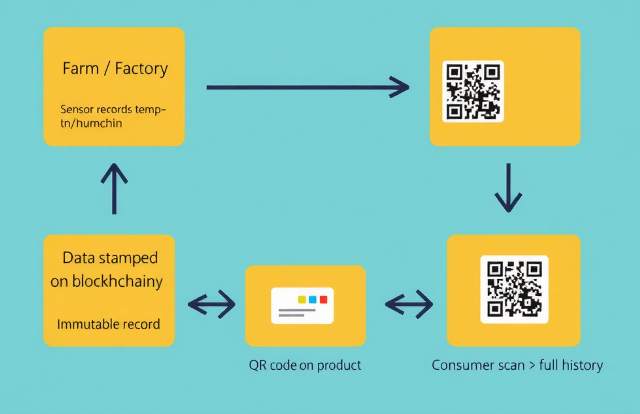
Consumer-facing implementation has become a genuine differentiator. Carrefour’s QR code programme – allowing shoppers to view a product’s farm of origin, feed, and handling details at the point of sale – is among the most cited examples of blockchain-driven consumer engagement in food retail.
How Blockchain Supply Chain Tracking Works
The fundamental principle is immutability: once data is written to the chain, it cannot be altered without detection. This makes blockchain particularly well-suited to provenance and audit applications, where the integrity of the record matters as much as the record itself.
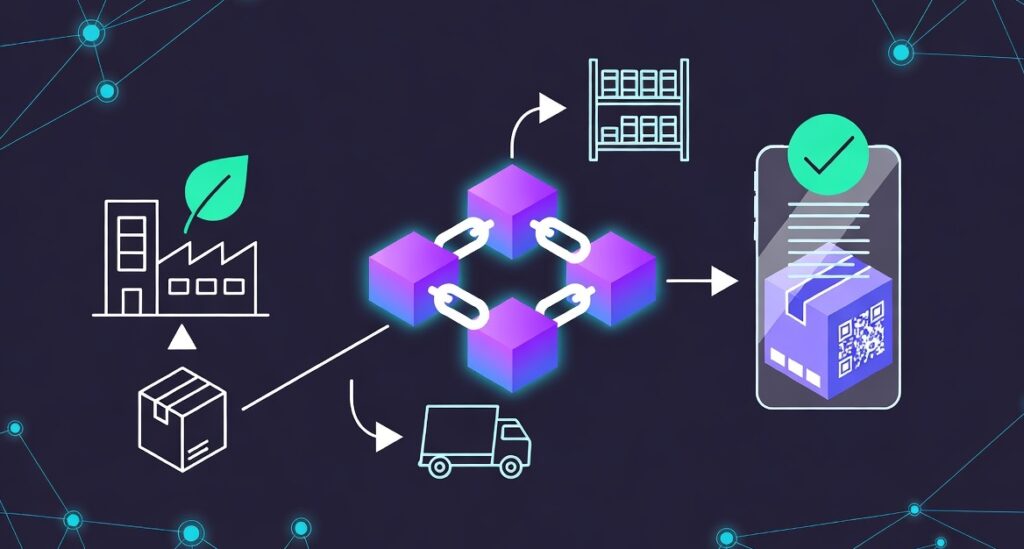
A product event – harvest, packaging, shipment, customs clearance, receipt – is recorded as a transaction on the blockchain by the relevant party at each stage. Each record is timestamped, linked to the prior record, and cryptographically signed. Any attempt to alter an earlier record invalidates the chain from that point forward, making falsification both difficult and detectable.
Oracle layers (such as Chainlink) allow off-chain data – temperature sensors, GPS coordinates, humidity readings – to be fed into the blockchain in a verified, tamper-resistant way, connecting physical logistics to the digital record.
2026 Technology Stack: What Enterprises Are Using
| Layer | Tool | Approximate Cost | Best For |
|---|---|---|---|
| Public | VeChain, Polygon | Below $0.01 per transaction | SMEs, consumer-facing QR code programmes |
| Permissioned | Hyperledger Fabric, IBM Food Trust | $5,000–$50,000 per year | Regulated industries (food, pharma) |
| Hybrid | OriginTrail | Pay-per-use | Cross-company data sharing and interoperability |
| Oracle | Chainlink | Free tier available | Feeding verified off-chain data (IoT sensors, temperature) |
VeChainThor is used by Walmart China, DNV, and a number of apparel brands, with NFC tags costing approximately $0.03 per item – low enough to be practical for high-volume consumer goods.
Documented Benefits
| Benefit | Supporting Evidence |
|---|---|
| Faster recalls | Walmart: food tracing reduced from days to seconds |
| Fraud reduction | Pharmaceutical counterfeiting substantially reduced on MediLedger-tracked lines |
| Sustainability proof | Patagonia traces its cotton supply chain as part of verified environmental claims |
| Dispute resolution | Maersk reported significant reductions in documentation-related disputes prior to TradeLens’ closure; successor systems have continued this work |
Case Study: Walmart and IBM Food Trust
Walmart partnered with IBM on the Food Trust network, built on Hyperledger Fabric, to trace food items – including leafy greens and pork – in real time. The collaboration documents a food item’s journey from farm to store in a transparent, tamper-resistant record accessible to authorised parties. Walmart subsequently made Food Trust participation a requirement for a significant number of its fresh produce suppliers, embedding the technology into procurement rather than treating it as optional.
Getting Started in 2026 (Including for Smaller Businesses)
Solutions like VeChain ToolChain and OriginTrail offer tiered entry points accessible to businesses without large IT budgets.
| Step | Estimated Time | Estimated Cost |
|---|---|---|
| Identify one high-value product for pilot | 1 week | No direct cost |
| Select a platform (e.g., VeChain ToolChain) | 2 weeks | $0–$10,000 depending on scope |
| Tag or QR-code inventory | 1 month | $0.03–$1.00 per item |
| Deploy QR codes on packaging and digital channels | 1 month | $500–$5,000 |
| Communicate provenance story (marketing, packaging) | Ongoing | Variable |
A realistic first-year budget for a brand with 50 SKUs is in the region of $8,000–$25,000. ROI timelines vary considerably by industry and implementation complexity; industry-reported averages typically range from 12 to 18 months.
Frequently Asked Questions
Q: Is blockchain supply chain tracking only for large companies?
A: No. Platforms like VeChain ToolChain and OriginTrail offer entry-level plans accessible to SMEs, with costs well below $500 per month at modest volumes.
Q: Is the data private?
A: On permissioned chains, only authorised parties can view detailed records. Public chain implementations allow companies to control which data consumers can access via QR codes or product pages.
Q: What is the most cost-effective starting point?
A: VeChain ToolChain offers a free tier with a pay-per-scan structure, making it a practical entry point for businesses wanting to pilot the technology with limited upfront commitment.
Final Thought
Blockchain supply chain tracking in 2026 is not a cryptocurrency story – it is a trust and verification story. The ability to prove provenance in seconds rather than days has material value in food safety, regulatory compliance, fraud prevention, and consumer engagement. The technology is sufficiently mature, affordable, and well-documented that the question for most businesses is no longer whether it works, but which implementation is right for their context.
Disclaimer:This content is for informational purposes only and should not be construed as financial advice. Always conduct your own research and consult with financial professionals before making investment decisio
 DefinedFi