Blockchain: What Is It, How Does It Work, and Why Does It Matter?
The word “blockchain” has been used to sell everything from supply chain software to digital art to financial revolutions. That volume of use has made it simultaneously overexposed and widely misunderstood. Ask ten people what a blockchain is and you will likely get ten different answers – some technically wrong, most incomplete.
This article starts from scratch and builds up, carefully. By the end, you will have a clear, accurate understanding of what a blockchain is, how it works mechanically, why its properties matter, and where it genuinely adds value versus where the hype has outrun the reality. Whether you are a curious first-timer or someone who works adjacent to the technology, this is written to serve both.
The Simple Version First
A blockchain is a database. But it is a database with three unusual properties:
- It is shared. Thousands of computers around the world hold an identical copy of it simultaneously.
- It is append-only. You can add new information, but you cannot change or delete what is already there.
- It is cryptographically linked. Each new record is mathematically connected to all the records before it, making undetected alteration practically impossible.
Those three properties, combined, produce something that did not exist before: a record of information that no single party controls, that anyone can verify, and that cannot be quietly altered after the fact.
That is what makes it useful – and that is what we will now build up from the foundations.
What Is a Database, and Why Does It Matter Here?
To understand blockchain, you first need a clear picture of how traditional databases work.
When you check your bank balance, your bank queries a database it owns and operates. That database records your account number, your balance, and every transaction. The bank can read it, update it, and – in theory – modify entries if it chose to. You trust the bank not to do that because of regulation, reputation, and legal accountability.
Most of the digital world runs on databases structured this way: one entity owns and controls the authoritative record. Google controls your Gmail data. Your bank controls your transaction history. A government controls the land registry. This is called a centralised model.
The centralised model works well when you trust the institution controlling the database. It creates problems when:
- The institution becomes insolvent (who controls the record now?)
- The institution is dishonest (who audits the auditors?)
- Multiple parties need to share a record but none trusts the others to maintain it honestly
- Participants are global and there is no single jurisdiction or authority
Blockchain was designed to address exactly these problems.
The Core Innovation: Distributed Consensus
The fundamental question blockchain solves is: how can multiple parties agree on a shared record of truth, without any single party being in charge of maintaining it?
This is called the consensus problem, and solving it reliably at scale is genuinely difficult.
Here is how blockchain approaches it:
Instead of one database on one server owned by one company, imagine 10,000 computers around the world each holding an identical copy of the same database. When someone wants to add a new record (a transaction, a contract, a shipment update), they broadcast it to the network. The computers (called nodes) collectively verify whether the record is valid according to the network’s rules. If a sufficient majority agrees it is valid, it gets added to all copies of the database simultaneously.
No single node is in charge. No single party can unilaterally alter the record. For a change to succeed, you would need to convince the majority of thousands of independent computers to accept it – simultaneously and faster than the rest of the network continues to grow. In practice, on large networks, this is computationally and economically infeasible.
Why “Blockchain”? The Structure Explained
The database is structured as a sequence of blocks, each containing:
- A set of validated transactions or data records
- A timestamp
- A reference to the previous block (called a hash)
A hash is a cryptographic fingerprint. Put any piece of data through a hash function and it produces a unique, fixed-length string of characters. Change even a single letter in the original data, and the hash changes completely and unpredictably.
Because each block contains the hash of the block before it, the entire chain is mathematically linked. If you tried to alter a transaction in block 500, the hash of block 500 would change. That would break block 501 (which references block 500’s hash), which would break block 502, and so on through every subsequent block – all the way to the present.
To successfully alter a historical record, you would need to recalculate every subsequent block faster than the entire active network continues to add new ones. On Bitcoin or Ethereum, this would require controlling an astronomically expensive proportion of the network’s computing power. The cost makes dishonest alteration economically irrational.
This is why blockchains are described as immutable: not because it is physically impossible to alter them, but because doing so is so costly as to be effectively impossible on well-established networks.
How Transactions Actually Work: A Step-by-Step
Let us walk through what actually happens when someone sends cryptocurrency on a blockchain – say, sending Bitcoin from one wallet to another.
Step 1 – Initiation The sender creates a transaction using their wallet software. The transaction specifies: sender address, recipient address, amount, and network fee. The sender signs the transaction with their private key – a cryptographic signature that proves they authorised it, without revealing the key itself.
Step 2 – Broadcasting The signed transaction is broadcast to the network, where it enters a pool of unconfirmed transactions (called the mempool on Bitcoin).
Step 3 – Validation Nodes on the network check the transaction against the network’s rules: Is the signature valid? Does the sender have sufficient funds? Is the format correct? Transactions that fail validation are rejected.
Step 4 – Block inclusion Miners (on proof-of-work networks like Bitcoin) or validators (on proof-of-stake networks like Ethereum) select valid transactions from the mempool and bundle them into a new candidate block.
Step 5 – Consensus The network’s consensus mechanism determines which candidate block gets added. On Bitcoin, miners compete to solve a computationally intensive puzzle (proof of work). On Ethereum, validators are selected probabilistically based on how much ETH they have staked. The winning block is broadcast to the network.
Step 6 – Confirmation Other nodes verify the new block and add it to their copy of the chain. With each subsequent block added on top, the transaction becomes more deeply embedded and more difficult to reverse. After six confirmations on Bitcoin, a transaction is considered settled.
Step 7 – Finality The recipient’s wallet reflects the updated balance. The transaction is now a permanent, publicly verifiable record on the blockchain.
This entire process takes roughly 10 minutes on Bitcoin and 12-15 seconds on Ethereum under normal conditions.
Public vs Private Blockchains
Not all blockchains are the same. A distinction that matters in practice is between public and private (or permissioned) blockchains.
| Public Blockchain | Private / Permissioned Blockchain | |
|---|---|---|
| Who can participate? | Anyone | Invited participants only |
| Who can read the data? | Anyone | Controlled access |
| Examples | Bitcoin, Ethereum, Solana | Hyperledger Fabric, Corda, VeChain (hybrid) |
| Control | Fully decentralised | Partially or fully centralised |
| Primary use cases | Cryptocurrency, DeFi, NFTs | Enterprise supply chain, trade finance, healthcare |
| Transaction cost | Variable (gas fees) | Often minimal |
Public blockchains prioritise decentralisation and open access. Private blockchains sacrifice some decentralisation in exchange for control, privacy, and performance – which is why they are often preferred in enterprise contexts where data confidentiality and regulatory compliance are required.
The distinction matters because the properties that make public blockchains valuable (permissionlessness, censorship resistance, open verification) are precisely what private blockchains limit. They are useful tools with different trade-offs, not a single category of technology.
Smart Contracts: Blockchain Beyond Currency
Bitcoin demonstrated that blockchain could replace trusted intermediaries for financial transfers. Ethereum extended that concept to code.
A smart contract is a program that runs on a blockchain. It is written once, deployed to the chain, and executes automatically when its conditions are met – without any human intervention or intermediary.
A simple analogy: a vending machine. You insert the correct amount, select your item, and the machine dispenses it automatically. There is no cashier involved, no possibility of the machine deciding to give your money to someone else, and no way to receive the item without paying. The rules are built into the mechanism.
Smart contracts work the same way, but for financial and contractual logic. Examples of what smart contracts enable:
- DeFi lending: “If address A deposits 1 ETH as collateral, allow address A to borrow up to 500 USDC. If the collateral value drops below 130%, automatically liquidate.”
- Escrow: “Release payment to the seller only when the buyer confirms receipt.”
- Governance: “Count votes from all token holders and execute the winning proposal automatically.”
- NFT royalties: “Any time this token is resold, send 10% of the sale price to the original creator’s address.”
Smart contracts made it possible to build entire financial systems – exchanges, lending markets, derivatives protocols – that operate without a company running them. That is the foundation of DeFi.
Where Blockchain Genuinely Adds Value
The honest answer to “where does blockchain actually help?” requires distinguishing between situations where its properties are genuinely necessary and situations where a traditional database would do the job better.
Blockchain adds clear value when:
- Multiple parties who do not fully trust each other need to share an authoritative record (trade finance, supply chain, cross-border settlement)
- Censorship resistance is a genuine requirement (financial access in authoritarian regimes, politically sensitive record-keeping)
- Transparency and public auditability matter inherently (charitable fund tracking, government expenditure, voting records)
- Eliminating intermediaries reduces cost meaningfully (international remittances, cross-border payments)
- Programmable, self-executing agreements reduce friction (DeFi, tokenised assets, automated royalties)
Blockchain adds less or no value when:
- A single trusted party could maintain the database more efficiently
- Privacy is paramount (public blockchains expose all transactions)
- Speed and scale are the primary requirements (most blockchains are slower than traditional databases)
- The problem is about data quality at the source, not record integrity (garbage in, garbage out – blockchain cannot verify that data entered is truthful, only that it has not been altered after entry)
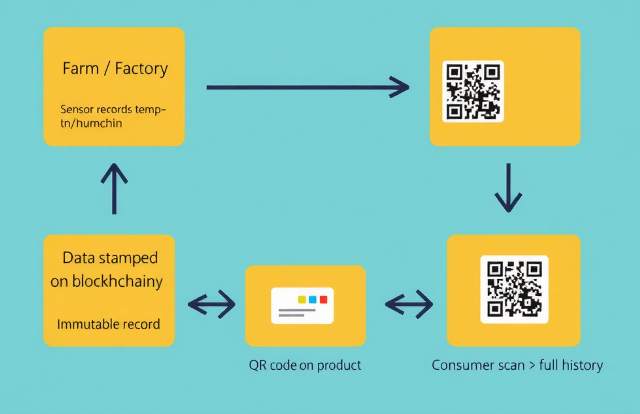
This last point deserves emphasis. Blockchain is exceptional at preserving the integrity of records after they are created. It cannot guarantee that the original data was accurate. A food supply chain system can record that a product was certified as organic – but blockchain does not verify the certification itself. That still requires human auditing.
Blockchain in 2026: The State of the Technology
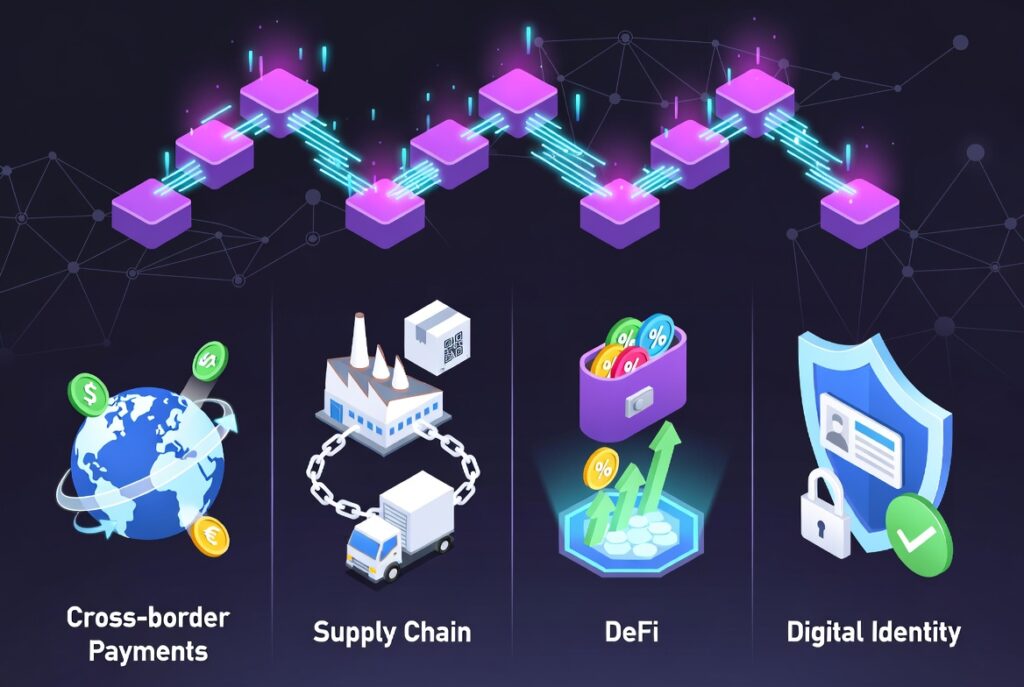
After more than a decade of development, blockchain has moved from speculative concept to operational infrastructure in several areas:
Financial markets: Major institutions including BlackRock, JPMorgan, and Goldman Sachs have deployed or are actively building on blockchain infrastructure for asset tokenisation, settlement, and fund administration.
Cross-border payments: Networks including Ripple and Stellar process significant volumes of cross-border transfers, with materially lower costs and faster settlement than correspondent banking.
Supply chain: IBM Food Trust (used by Walmart, Carrefour, and Nestlé) has demonstrated that food traceability can be reduced from days to seconds using Hyperledger Fabric.
Decentralised finance: As of early 2026, DeFi protocols collectively manage tens of billions of dollars in assets, offering lending, trading, and yield generation without traditional intermediaries.
Digital identity: Self-sovereign identity projects – allowing individuals to own and selectively share verified credentials – are progressing from pilot to deployment in several jurisdictions.
The technology is not a solution to every problem. Its adoption has been slower than early advocates predicted and faster than early sceptics expected. Where it has taken hold, it has done so in areas where its specific properties – decentralisation, immutability, and programmability – address genuine limitations in existing systems.
Key Terms, Defined Simply
Blockchain – A distributed, append-only database where records are grouped into linked blocks and maintained by a network of computers without a central authority.
Node – A computer participating in a blockchain network, holding a copy of the full chain and helping to validate new transactions.
Hash – A cryptographic fingerprint of data. Unique to the input, fixed in length, and completely changed by any alteration to the source.
Consensus mechanism – The rules by which a distributed network agrees on which transactions are valid and which new block gets added. Proof of work and proof of stake are the two dominant approaches.
Smart contract – Self-executing code deployed on a blockchain that runs automatically when predefined conditions are met.
Private key – A secret cryptographic string that proves ownership of a blockchain address and authorises transactions. Never share it.
Wallet – Software that manages your private keys and allows you to sign and send transactions. Your assets live on the blockchain; the wallet is the interface.
Gas – The unit measuring computational effort required to execute a transaction or smart contract on Ethereum. Users pay gas fees to compensate validators.
Decentralisation – The degree to which control and decision-making is distributed across participants rather than concentrated in a single entity.
Final Thoughts
Blockchain is not magic. It is a specific technical architecture with specific properties that solve specific problems – problems that arise when trust between parties is absent or insufficient, and when the integrity and auditability of shared records matter.
Understanding what it actually does – and what it does not do – is the prerequisite for evaluating any blockchain application honestly. The technology has earned its place in the legitimate financial and logistical infrastructure of the world. Whether any particular use of it is well-suited to blockchain’s properties is always worth asking.
The more that question is asked clearly, the better the outcomes for everyone building on, investing in, or simply trying to understand this technology.
Disclaimer: This article is for educational purposes only. It does not constitute financial or investment advice. The blockchain ecosystem evolves rapidly; readers are encouraged to verify current developments independently.

 DefinedFi