
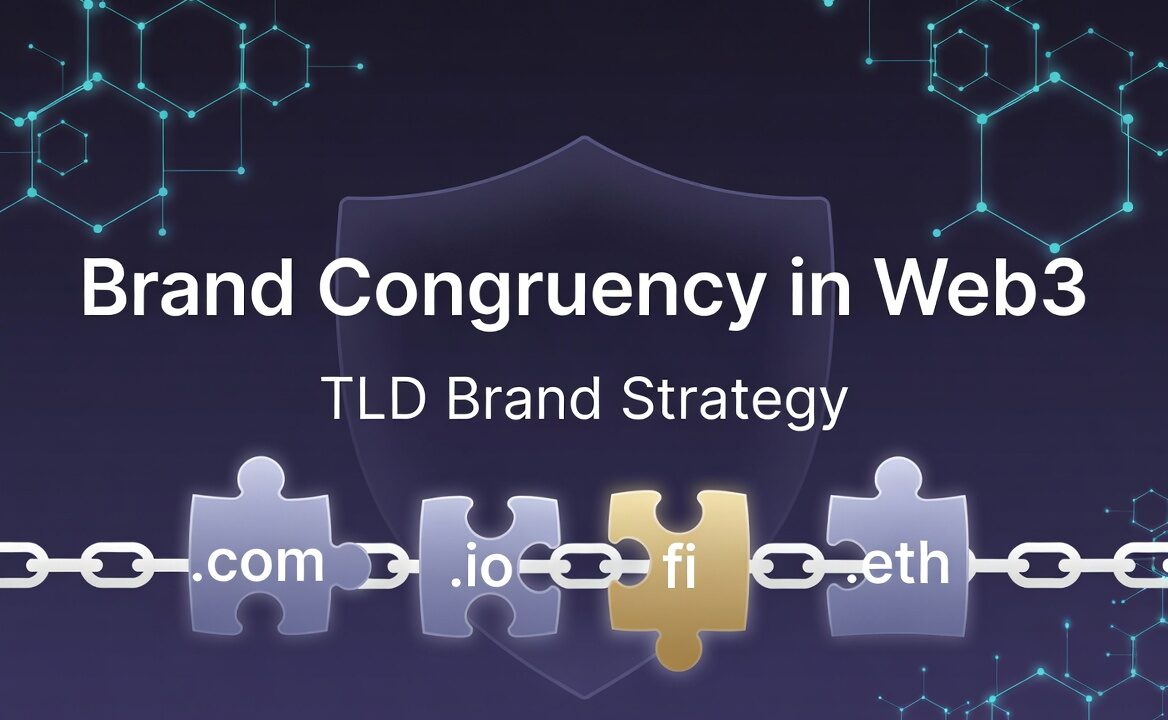
The Decentralized Finance ecosystem is undergoing a profound metamorphosis. What began as a grassroots movement characterised by experimental protocols and highly technical early adopters is rapidly maturing into a foundational pillar of global finance. As this space transitions into its long-anticipated institutional phase, the prerequisites for success are shifting. It is no longer enough to have the most innovative smart contracts or the fastest indexing API. Protocols must now project absolute, undeniable trust.
In this new era, the visual and digital markers of legitimacy are becoming just as critical as the underlying code. At the forefront of this digital identity is the Top-Level Domain. While Web3-native extensions like .fi, .exchange, .xyz, and .io were starter vehicles for building early community identity, the reality of global enterprise adoption is forcing the industry into a domain strategy reckoning it has largely deferred. The decisions that leading protocols are making – or failing to make – about their primary domain extensions are quietly shaping who gets to serve institutional capital in the decade ahead.
1. The Psychology of TLD Stability
To understand why traditional finance and enterprise entities care so deeply about domain extensions, one must examine the psychology of institutional risk management.
The Fiduciary Mindset and the Psychological Anchor
Institutional capital – particularly those managed by hedge funds, family offices, asset managers, and corporate treasuries – operates under strict fiduciary duties. When these entities look to integrate a Web3 data provider or API into their workflow, their due diligence process is exhaustive. They are fundamentally risk-averse, actively seeking digital markers that signal safety, compliance, and permanence.
For these traditional entities, a .com domain acts as a psychological anchor. Since the dawn of the commercial internet, .com has been synonymous with established, legally incorporated, and heavily scrutinised businesses. When a compliance officer or Chief Technology Officer evaluates a new vendor, a legacy TLD communicates a specific tier of institutional seriousness. It functions as a heuristic, a mental shortcut that bypasses the reflexive scepticism many institutional actors still extend to the crypto industry as a category.
This is not irrational behaviour. It is pattern recognition built on decades of internet experience in which .com has reliably correlated with incorporated entities, auditable legal structures, and operational permanence. That correlation is not perfect, but it is statistically robust enough to function as a first-pass filter in institutional due diligence.
Crossing the Chasm: From Community Tool to Enterprise Standard
The use of alternative TLDs was a necessary and deliberately chosen branding strategy during the startup phase of decentralised finance. A .fi extension signals fintech orientation. A .exchange extension signals market-making heritage. An .xyz signals Web3 nativity. These choices were correct for their moment – they signalled cultural alignment to developers and retail users who were themselves native to the space.
However, as protocols scale from serving retail traders to serving enterprise clients, the messaging embedded in a domain extension must evolve with them. A Web3-specific TLD can inadvertently communicate that a company is still in an experimental or transient phase, precisely the signal that institutional counterparties are trained to treat with caution. Upgrading to a primary .com is the digital equivalent of moving from a co-working space into a permanent corporate headquarters. It signals to the market that the protocol has crossed the chasm from successful startup to mature, durably capitalised enterprise.
2. How the Market’s Leaders Have Navigated This
The domain strategies of DeFi‘s most established protocols offer a revealing window into how different approaches to TLD have played out in practice, and what the industry’s institutional evolution is beginning to demand.
Aave: The Clean .com Acquisition
Aave presents the clearest case study in proactive domain strategy. The protocol operates its primary presence at aave.com, a clean, unambiguous .com that has supported its transition from a retail lending protocol into a platform courting institutional liquidity providers and treasury managers. The .com creates no cognitive friction for a traditional finance counterparty arriving through a Google search or a vendor evaluation process. There is no TLD to explain, no alternative extension to validate. The domain does passive credibility work before a single product feature is evaluated.
Uniswap: The .org Compromise with .com Redirect
Uniswap, by contrast, operates its primary interface at uniswap.org, a choice that made cultural sense for a decentralised protocol positioning itself as community infrastructure rather than a corporate product, but which created a subtle friction point as the protocol pursued institutional legitimacy. The .org TLD is widely associated with non-profit and open-source entities, which can read ambiguously to institutional compliance teams evaluating a counterparty’s corporate structure and accountability. In a bid to address this friction, Uniswap acquired uniswap.com, which redirects to app.uniswap.org. While the purchase price isn’t public, it is projected to be a mid-six-figure investment.
Crypto.com: The Acquisition That Tells the Story
Crypto.com’s domain evolution illustrates why early domain strategy matters. The platform began as mona.co, aligning with its Monaco branding and serving its initial crypto-native audience. As the company targeted institutional clients, it became evident that a non-standard domain limited credibility, regardless of product quality. In 2018, the company reportedly paid $12 million for crypto.com, and the transition required extensive rebranding, user redirection, partner reassurance, and costly efforts that could have been minimized with an early domain strategy. This case underscores how initial decisions have lasting consequences.
Curve Fintech: The .app to .com transition
Curve UK Ltd operated at curve.app, as a fintech providing “smart wallet” services, a central hub for all bank cards. When the company expanded internationally, it acquired curve.com for £273,000 (approximately $338,000 at the time) in 2020, as part of a major branding upgrade, positioning it for institutional and global opportunities. This acquisition transitioned the company from a “fintech startup” to a “tier-one financial institution. Curve was acquired by Lloyds Banking Group for approximately £120 million (about $157 million) in a deal reported in mid-November 2025. The reputational weight of a .com is real, and for institutional investors like Lloyds Banking Group, a premium .com domain is a validated financial asset and a strategic moat.
3. Cognitive Load and Brand Protection
Beyond institutional signalling, owning the primary .com that matches a platform’s social handles and brand identity is a foundational cybersecurity measure. In Web3, where transactions are immutable and customer support cannot reverse a stolen transfer, brand congruency is a direct security feature.
The Danger of Cognitive Friction
Brand congruency refers to the seamless alignment of a company’s identity across all digital touchpoints. When a platform achieves significant visibility, users develop habituated patterns around interacting with that brand. The human brain seeks the path of least resistance. When a developer or trader sees an announcement from a handle – @protocol across X, GitHub, Discord, and NPM package registries – their natural inclination when visiting the platform is to type that handle directly into a browser address bar, appending .com as the default extension.
If the platform does not operate that .com, it creates cognitive friction. The user must stop, search, verify the correct alternative TLD, and hope they have not inadvertently clicked a malicious advertising result in the process. In high-stakes financial environments where users are connecting wallets and authorising transactions, that friction is not merely a user experience inconvenience. It is a moment of heightened vulnerability.
This problem is particularly acute for protocols whose brand identity and social handles have become tightly associated with a specific string of characters. The gap between where users expect to arrive and where they actually need to go is precisely the gap that bad actors exploit.
Shrinking the Attack Surface
The Web3 industry has documented a persistent pattern of phishing attacks built on look-alike domains. Scammers routinely register the .com, .co, or .net variants of platforms operating primarily on .fi, .io, or .exchange extensions, using those domains to intercept confused users, drain connected wallets, and steal API credentials.
Controlling the exact-match .com is an aggressive defensive move. It does not eliminate phishing risk, but it removes the single most obvious vector – the domain a user types from habit – and routes that traffic to the authentic platform. For protocols processing significant transaction volume or serving API clients whose integrations carry financial consequence, this is not a marginal security consideration. It is a baseline.
4. The SEO Reality: Backlinks, Not Algorithms
One persistent misconception in domain strategy discussions is the claim that search engines algorithmically favour .com domains. Google has been consistent and public in its position: TLD does not directly influence rankings. A well-run .fi or .org can rank equally to a .com on technical SEO merit – domain authority, content quality, and backlink profile are what determine search visibility.
However, the indirect effect of TLD on search authority is real and statistically observable, even if the mechanism is different from what is often claimed.
The compounding SEO reality is this: high-authority backlinks from traditional financial media, academic institutions, regulatory publications, and enterprise technology blogs disproportionately target .com domains. This is not an algorithmic preference; it is an editorial one. A journalist at the Financial Times or a researcher publishing through an academic institution is statistically more likely to link to a .com than to a .fi or .exchange, because their own domain authority depends on linking to properties their audiences perceive as credible, and .com carries that perception in traditional publishing environments.
For a platform whose growth depends on institutional inbound with compliance officers evaluating a vendor, CTOs researching an API integration, and asset managers conducting initial due diligence, this backlink asymmetry has real consequences for search visibility on the keywords that matter most. The advantage is not algorithmic. It is sociological. And in practice, the effect on organic institutional discovery compounds over time.
5. The Path to Permanent Domain Status
The domain strategies of Web3’s most successful protocols are converging toward a common insight: that building institutional trust requires not just technical excellence but holistic brand architecture. The protocols that will capture and retain institutional capital in the next decade are those that have made their brand identity as frictionless to engage with as their technology is to integrate.
Unifying Digital Identity
For any infrastructure platform building toward enterprise adoption, the brand architecture surrounding the core product must be as reliable as the product itself. Institutional clients evaluating a high-fidelity data API or a trading infrastructure platform do not want to piece together a fragmented digital identity, such as a .fi here, a .io there, or social handles that suggest a .com that doesn’t resolve to the canonical platform. They want a single, unambiguous source of truth. Consolidating brand presence under a primary .com achieves that singularity, aligning the consumer product, developer documentation, enterprise API, and social presence into a single, coherent institutional-grade package.
Permanence as a Market Signal
Ultimately, securing the .com that matches a platform’s established brand identity is a declaration of permanence. It signals to the market, to competitors, and to prospective institutional partners that the platform is not a transient participant in a volatile industry. It is the domain equivalent of a long-term office lease, not because the lease makes the company more valuable, but because it signals that the company is building for a timeline that justifies the commitment.
As decentralised finance continues its convergence with traditional finance, the protocols that will define the next decade are those that have treated trust not as a feature to be added after product-market fit, but as a design constraint built into every layer of how they present themselves to the world. Domain strategy is not the most technically complex of those layers. It is, however, one of the most visible, and for institutional counterparties arriving with risk-management instincts sharpened over decades of internet history, it is frequently among the first things they see.
The industry’s institutional moment is here. The domain strategy reckoning it demands is already underway.

 Jesse Williams