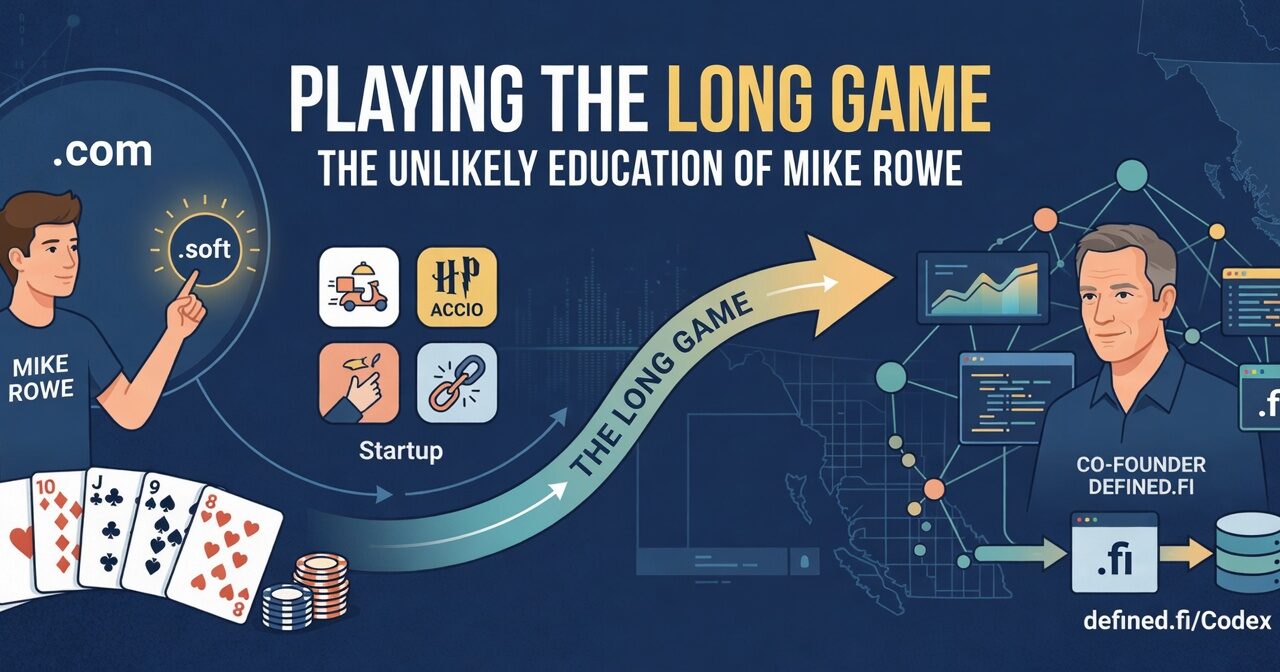
The co-founder of Defined.fi learned what a domain is worth at 17. What came after – five years at a poker table, a string of startups, and a DeFi data platform still making its case – is the rest of the story.
In January 2004, a grade 12 student in Victoria, British Columbia, received a legal package from Microsoft’s Canadian lawyers. He had, it turned out, committed an offence: his name was Mike Rowe, and he had added the word “soft” to the end of it.
“Since my name is Mike Rowe,” he later explained with the tone of someone who has had to explain this many times, “I thought it would be funny to add ‘soft’ to the end of it.” The website, mikerowesoft.com, was a portfolio for his part-time web design business. He had, by his own count, approximately two visitors per day. “One was me, one was my mom.”
Microsoft’s lawyers were not amused. Their cease-and-desist letter spanned 25 pages. Their opening settlement offer was $10, the exact cost of registering the domain. The 17-year-old’s counter-offer was $10,000. Their response was to escalate to the World Intellectual Property Organization. His response was to call the press.
What followed was the kind of story the early internet was uniquely built to produce: a David-and-Goliath saga that generated 250,000 page views in twelve hours, crashed his server, made international news, prompted $6,000 in public donations, and turned a teenager from Victoria into a briefly famous symbol of individual defiance. He settled. Microsoft got the domain, he got considerably more than the Xbox that has become the punchline, and then moved on with his life.
The question of where that life went next is more interesting than the settlement that launched it.
What He Actually Got
Before going further, a correction is overdue. The Xbox is what everyone mentions. It is not only what everyone should mention.
The settlement package Microsoft provided included:
- Hardware: An Alienware laptop, which a former classmate later remembered him lugging through the University of Victoria, the machine reportedly sounding “like a leaf blower.”
- Software and Subscriptions: A three-year subscription to the Microsoft Developer Network (MSDN), which included a library of approximately 1,000 CDs containing various software tools.
- Training: Programming training in Visual Basic.net. Rowe later stated that he found the language unappealing.
- Corporate Access: Three all-expenses-paid trips to Microsoft’s corporate headquarters in Redmond, Washington, and unrestricted shopping privileges at the Microsoft employee store. “They pretty much let me go wild,” he recalled.
In addition to the direct settlement, the temporary surge in web traffic allowed Rowe to generate roughly $20,000 in advertising revenue, enough to buy his first car – a 1988 Honda Prelude. The $6,000 raised by the public for his legal defense was donated to Canuck Place, a hospice for children in Victoria. He put the original 25-page legal document on eBay as “a piece of internet history.” It attracted bids that topped $200,000, which were later found to be fraudulent. After restricting the auction to pre-approved bidders, it sold for $1,037.
Rowe later reflected on the negotiation with a characteristic glibness, suggesting that with the benefit of hindsight, he might have set his initial counter-offer at $100,000 to “make it more interesting.” When interviewed on TechTV regarding his plans for the Xbox, he noted his intention to install the Linux operating system on the hardware.
The Table as Classroom
After the settlement, Mike Rowe did not go straight into founding the next thing. He played poker for five years, and this is the part of the story that most retellings skip entirely, possibly because it is harder to fit into a tidy founder narrative.
He started at 18, after winning a casual home game at a friend’s house. The competitive reflex that had sustained him through Red Alert 2, Counter-Strike, and Day of Defeat – “pretty much everything I get addicted to, I don’t stop playing until I think I can’t get any better”- recognised a new arena. Poker was a video game, except the levels were buy-in denominations, and clearing them paid actual money, which funded the purchase of his first condo.
He was self-taught, learning through forums rather than traditional instructional books. He began his professional trajectory with four deposits of $50 each, and worked up from the smallest available stakes. His significant career milestones included:
- Tournament Success: He placed 5th in the PokerStars Sunday Million, earning $97,500, and 31st in the PokerStars Caribbean Adventure, which yielded $40,000.
- Financials: He reported annual earnings of approximately $100,000. However, he noted the extreme volatility of the profession, stating his earnings were often “plus or minus $100,000.”
- Lifestyle: His daily routine typically involved two to four hours of active play, primarily on the iPoker network. The remainder of his time was spent traveling throughout Europe, North America, Mexico, and the Caribbean.
What the poker years produced, practically speaking, was sustained exposure to decision-making under incomplete information, enhancing his skills for reading situations rather than surfaces, and calculating expected value in conditions where the outcome is never guaranteed. Whether those skills transferred directly into founding a technology company is a question he has not made a particular case for; the pattern, looking back, is at least suggestive.
His description of what motivated him at the table is candid. “It kinda sounds sick and twisted, but I’m never satisfied winning a large amount of money on one day. I get a bigger rush from digging myself a huge hole and then getting out of it. I feel better when I am down $2000 an hour into my session and end up breaking even to end it than I would be winning $2000.”
He called it plainly what it was: “a profitable gambling addiction – not denying it. I just found a way to make my addiction profitable.” Eventually, he returned to building things, and in retrospect, described professional poker as “a boring and stressful career” he would not recommend. The condo, at least, survived the experience.
ForkJoy, and the Value of Honest Failure
When the poker chapter waned, Rowe moved back into internet businesses. The next few years involved, in his own words, “a couple of unsuccessful startups.”
ForkJoy was among them: a mobile application offering searchable restaurant menus with photos and crowdsourced reviews, with an eventual delivery component. The delivery component never found its business model. The company folded, but the experience left one useful residue: the observation that people in Victoria wanted food delivered to them, and that a menu platform was not the only way to enable it. In March 2015, Rowe and his partner launched Accio, a localized delivery service in Victoria.
The venture was started with a budget of $300 and relied on a simple technical premise: customers would text the word “ACCIO” to a dedicated phone number to request the delivery of legal goods within the city. The company grew from a text message into a commercial kitchen, a delivery fleet, a mobile app, and a small team. Despite reaching operational scale, the business was severely impacted by the COVID-19 pandemic, and Accio ultimately ceased operations.
Rowe described the closure as a significant personal and professional setback but noted that it provided practical experience in validating business ideas with minimal capital and scaling operations based on actual market traction. “It took a long time to get over it,” he said, “but Accio failing was the best thing that ever happened to me. I also don’t regret a single thing about it.”
The approach Accio demonstrated – validate cheaply, scale only what traction justifies, and treat failure as information – would show up again in how the defined.fi team built a data infrastructure. Whether this represents a consistent philosophy or the pattern that emerges when you retrospectively connect enough dots is a question reasonable people can disagree on.
Liftoff, and Building With the Right People
After Accio, Rowe joined Liftoff, a small Victoria-based product studio within the Tiny Capital ecosystem, the holding company founded by Andrew Wilkinson that includes Dribbble and MetaLab, among others. Tiny’s approach tends toward capital efficiency, long time horizons, and small focused teams, a reasonable fit for where Rowe had been pointing.
Liftoff worked on several projects, including Supercast, a premium podcast infrastructure platform, and Letspush, an app that lets people automatically track their Orangetheory Fitness (OTF) and other workouts. When the team pivoted away from Letspush, Rowe posted a public invitation for developers to take over its maintenance: “We know that a lot of people still use it, including us, but would love to see some more development happen on it. If you’re looking for a fun side project, this might be it.” The project was handed off, and the team moved on.
The pivot was defined.fi. The Liftoff team, comprising Rowe, technical co-founder and system architect Braden Simpson, Nathan Lambert, Derek Binnersley, and others, had been trading and building in decentralized finance and kept hitting the same problem: the existing data tools were slow, unreliable, and expensive to work around. Price data across multiple chains was siloed, and developers were spending most of their engineering time on data pipelines rather than on the products those pipelines were supposed to serve. To address these gaps, the team built a data terminal. “We build awesome products, and I get to work with my friends every day,” Rowe wrote at the time. It is not a complicated statement, and it was probably not meant to be.
The Platform Built on Internal Need
Starting from their own trading frustrations, the Defined team built a terminal: a real-time, multi-chain data platform for tracking prices, liquidity pools, and wallet activity at the speed professional trading requires. When no existing third-party API delivered the necessary data fidelity, they built their own indexing engine. Because they were using it themselves under live market conditions, failures were felt immediately and fixed quickly.
That engine became the Codex API, which was extracted from the defined.fi’s internal infrastructure and offered to third-party developers as a standalone product. It now serves as data infrastructure for wallets, DEXs, payment processors, and trading applications across more than 80 blockchains. The business logic behind externalising it follows the same pattern that made infrastructure businesses like AWS durable: serving other people’s products is a more defensible position than competing for their users. Whether Codex achieves that kind of structural importance remains to be seen; the architecture is designed with that ambition in mind.
Rowe has described the original goal as building the “front page of DeFi.” Two decades after the internet introduced him to the weight that names and addresses carry, he is running a company whose identity lives in a domain ending in .fi.
The Geometry of Digital Identity
There is a connection between mikerowesoft.com in 2003 and defined.fi today. In the early 2000s, the battle was over a phonetic pun; today, the focus is on defined.fi, where the “.fi” suffix is Finland’s official country code and is used by fintech startups. At 17, Mike Rowe experienced domain identity as a high-stakes legal issue rather than just a marketing concept. He learned publicly that a URL is more than a digital address; it is a strategic asset and a point of leverage. It’s still unclear if this encounter with Microsoft left a lasting impression on how he thinks about digital brand identity and brand gravity.
The Persona vs. The Record
When asked to define himself or his motivations directly, Rowe tends to retreat into the self-deprecating: “Optimistic about most things, have a pretty good sense of humour and can make people laugh a lot. Long walks on the beach. Etc, etc.”
It is a glib response, typical of a founder who grows slightly uncomfortable when the questioning turns too earnest. However, the record provides the data that the quote obscures. The optimism isn’t just a personality trait; it’s a documented constant. It is visible in the teenager who chose a media firestorm over a $10 settlement, in the poker player who derived more satisfaction from digging himself out of a hole than winning a “clean” hand, and in the founder who viewed a pandemic-shuttered business as a necessary evolution rather than a defeat.
The Infrastructure Bet
The ultimate fate of defined.fi remains an open question, as it must be in the volatile landscape of decentralized finance. However, the thesis underpinning it – moving from the “joke” domain of his youth to the “infrastructure” domain of his career – is logically sound. The team is experienced, and the market for high-fidelity DeFi data is both vast and underserved.
The success of this final chapter will depend on execution, timing, and the myriad of external factors that neither a founder nor a chronicler can fully anticipate. That uncertainty, more than a neatly tied-up conclusion, is the most honest place to leave a story that is still very much in progress.
Mike Rowe is Co-Founder and CEO of defined.fi and Codex (codex.io). He is based in Victoria, British Columbia, where he still plays hockey, and is, by his own assessment, considerably worse at it than he was 22 years ago.

 DefinedFi