
Low-Risk DeFi Lending Platforms 2026: A Realistic Guide to Earning Steady Yields
DeFi lending has matured substantially over the past several years. What was once a niche activity associated with significant volatility and complexity has evolved into a structured, relatively accessible way to earn yields on stablecoin holdings – for those willing to understand the mechanics and accept the residual risks involved.
This guide focuses on established, audited lending platforms where realistic yields on stablecoins are achievable, without the elevated risk profile of high-leverage or high-APY farming strategies. It is written for readers who want an honest, grounded picture of what DeFi lending currently offers.
What Makes DeFi Lending “Lower Risk” in 2026?
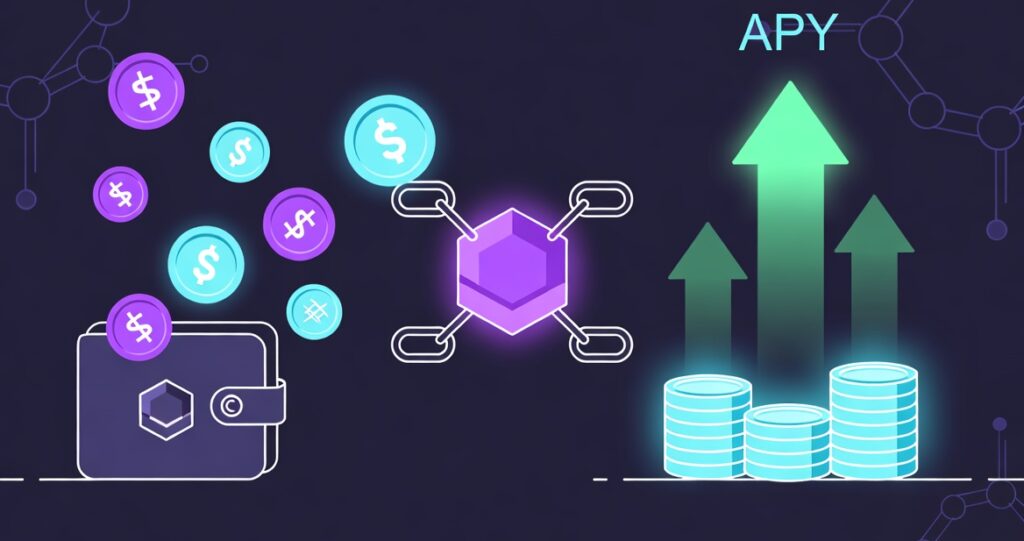
DeFi lending operates on a straightforward principle: you supply cryptocurrency to a lending pool, borrowers pay interest to access those funds, and you earn a proportional share of that interest. As a yield farming strategy, DeFi lending provides means for token holders to maximize returns on their assets. Withdrawals are generally available at any time, subject to available liquidity.
The structural features that distinguish lower-risk DeFi lending from higher-risk strategies include:
- Over-collateralisation: Borrowers are required to deposit collateral worth significantly more than the amount they borrow – commonly 130-150% or above, depending on the asset and platform. This provides a buffer against borrower default.
- Established protocols: The platforms covered here have operated through multiple market cycles, undergone repeated independent audits, and maintained substantial liquidity over extended periods.
- Stablecoin focus: Lending in USDC or USDT removes direct exposure to crypto price volatility, though stablecoin-specific risks remain (discussed below).
- Layer 2 deployment: Major protocols are now fully operational on Ethereum Layer 2 networks, substantially reducing transaction costs.
Comparison with traditional alternatives:
| Traditional Savings (2026) | DeFi Lending (2026) | |
|---|---|---|
| APY | 3.5–5% (high-yield accounts, varies by region) | 2–8% (stablecoins, varies by platform and conditions) |
| Protection | Deposit insurance where applicable (e.g., FDIC up to $250K in the US) | Smart contract audits; no deposit insurance |
| Custody | Bank holds funds | You maintain custody via connected wallet |
| Rate type | Often fixed or tiered | Variable, based on supply and demand |
It is worth noting that the yield differential between DeFi lending and traditional high-yield savings accounts has narrowed compared to previous years, as central bank rate cycles have affected both sides of the comparison. The decision to use DeFi lending should be based on a clear-eyed assessment of the actual yield difference versus the additional complexity and risk involved.
Established DeFi Lending Platforms
The following platforms are included on the basis of operational longevity, audit history, and sustained total value locked. TVL and APY figures are inherently time-sensitive and should always be verified directly on the platform before depositing.
1. Aave
- Approximate TVL: Among the largest in DeFi lending; consistently above $10B across all chains
- Typical USDC APY: Variable; broadly in the 2-6% range on Base and Ethereum mainnet under current market conditions
- Chains: Ethereum, Polygon, Arbitrum, Base, and others
- Why it is established: Multiple years of operation, extensive independent audits, isolation modes for higher-risk asset classes, and one of the deepest liquidity pools in DeFi
2. Compound
- Approximate TVL: Materially smaller than Aave in recent periods; figure varies
- Typical USDC APY: Variable; broadly in the 2–5% range
- Chains: Ethereum, Base
- Why it is established: Historically one of the foundational DeFi lending protocols; battle-tested codebase with a long audit history
3. Sky Protocol (formerly MakerDAO)
- Approximate TVL: Substantial; figure varies with DAI/USDS supply
- Sky Savings Rate (SSR): Variable; has ranged from 4–8% in recent periods
- Chain: Primarily Ethereum
- Why it is established: The longest-running major DeFi protocol. MakerDAO rebranded to Sky Protocol in August 2024, with the DAI Savings Rate transitioning to the Sky Savings Rate. The core mechanics and governance structure remain consistent with its earlier form.
4. Morpho
- Approximate TVL: Growing significantly; figure varies
- Typical USDC APY: Often higher than Aave base rates due to peer-to-peer matching optimisation; variable
- Chains: Ethereum, Base
- Why it is notable: Morpho optimises lending and borrowing by matching counterparties peer-to-peer where possible, improving effective rates for both lenders and borrowers above the underlying pool rates
Important: All APY figures in DeFi lending are variable and can change materially within hours based on pool utilisation. Always check live rates on the platform directly before making any deposit decision.
Getting Started: Your First DeFi Lending Experience
Step 1 – Choose your setup
- Wallet: MetaMask or Coinbase Wallet
- Starting amount: $100–$500 is a practical range for learning the process without material financial exposure
- Asset: USDC or USDT to avoid direct price volatility
- Chain: Base or Arbitrum for low transaction fees
Step 2 – Make your first deposit
- Purchase USDC on a reputable centralised exchange.
- Transfer to your self-custody wallet and bridge to your chosen Layer 2 network if required.
- Navigate to the lending platform (e.g., app.aave.com).
- Connect your wallet and supply your chosen stablecoin.
- Monitor your position regularly.
Step 3 – Understand what you are earning
- Base interest: Paid by borrowers using your supplied funds.
- Incentive tokens: Some platforms periodically offer additional governance or reward tokens on top of base interest. These should be evaluated separately, as their value can be volatile.
- Compounding: Interest on most platforms accrues continuously and compounds automatically.
Real Risks You Should Understand Before Depositing
“Lower risk” in DeFi is a relative term. No DeFi deposit is without risk.
Smart Contract Risk The code governing the protocol could contain undiscovered vulnerabilities. Even well-audited platforms have experienced exploits historically. Mitigation: use only protocols with extensive, recent audit histories and strong track records. DeFiSafety scores provide a useful starting reference.
Stablecoin Risk USDC and USDT could lose their 1:1 peg to the US dollar. USDC experienced a brief de-peg in March 2023 following the Silicon Valley Bank collapse, though it recovered. Mitigation: understand the backing and redemption mechanics of your chosen stablecoin; diversify across stablecoins for larger holdings.
Regulatory Risk Government actions could affect platform access, stablecoin issuers, or the legal status of DeFi activity in your jurisdiction. Mitigation: stay informed about regulatory developments relevant to your location; do not commit funds you cannot afford to have access disrupted.
Liquidity Risk In stress scenarios, withdrawal capacity can be constrained if a high proportion of supplied assets are borrowed. Mitigation: use platforms with deep liquidity and avoid depositing funds you may need urgently.
DeFi Lending vs. Centralised Finance (CeFi) Lending
| Feature | DeFi Lending | Centralised Platforms |
|---|---|---|
| Custody | You hold private keys | Platform holds funds |
| Transparency | On-chain, publicly auditable | Dependent on platform disclosure |
| Access | Permissionless, 24/7 | KYC required; subject to platform policies |
| Primary risk | Smart contract vulnerabilities | Platform insolvency, regulatory action, counterparty risk |
Several major CeFi lending platforms – including Celsius, BlockFi, and Genesis – became insolvent during the 2022–2023 period, resulting in significant losses for users. This history is directly relevant to any comparison between DeFi and CeFi lending, and should inform how counterparty risk in CeFi is evaluated. CeFi has however evolved with platforms like Binance having deep liquidity, providing crypto-collateralized loans at competitive rates.
Practical Guidance for Getting Started
Start conservatively. Begin with $100–$500 on an established platform using stablecoins. The goal of a first deposit is to understand the mechanics, not to maximise yield.
Diversify thoughtfully. If you deploy larger amounts over time, consider spreading across two or three established protocols rather than concentrating in one.
Keep liquidity reserves. Do not deposit emergency funds. Maintain a separate reserve in traditional savings.
Stay informed. Monitor protocol announcements and governance discussions. Material changes to platform mechanics or risk parameters are typically discussed in public governance forums before implementation.
Tax Considerations
In most jurisdictions, including the United States, yields earned from DeFi lending are treated as ordinary income at the point they are received or become claimable. All transactions – deposits, withdrawals, reward claims – should be recorded. Crypto-specific tax software such as Koinly or CoinTracker can assist with this. Consult a qualified tax professional for advice specific to your circumstances.
Frequently Asked Questions
Q: Is DeFi lending appropriate for beginners?
A: It can be, with appropriate caution. Start small, use established platforms, read the documentation, and understand the risks before depositing. Never invest more than you can afford to lose.
Q: How much can I realistically earn?
A: On stablecoins via established platforms in current market conditions, a realistic range is 2-8% APY depending on the platform, chain, and prevailing supply/demand. This varies continuously.
Q: Do I need technical knowledge?
A: A basic understanding of wallets, bridging assets, and smart contract interactions is helpful. Modern platforms have improved significantly in usability, but DeFi still requires more active engagement than a traditional savings account.
Q: What is the practical minimum to start?
A: Technically, as little as $10–$50, but transaction fees make very small amounts inefficient. $100–$500 is a more practical starting range for the learning phase.
Final Thoughts
DeFi lending in 2026 offers a legitimate, non-custodial way to earn yields on stablecoin holdings that, in many cases, remain competitive with or superior to traditional savings accounts – particularly for users who value self-custody and permissionless access. However, the yield advantage has narrowed compared to prior years as conventional interest rates have risen, and the risks involved – however manageable on established platforms – are real and distinct from those of regulated deposit accounts.
The appropriate approach is: start conservatively, use audited and established protocols, diversify across platforms for meaningful amounts, and never treat DeFi yields as a guaranteed or risk-free return.
Disclaimer:This article is for educational purposes only and does not constitute financial or investment advice. Always conduct your own research (DYOR) and consult a qualified financial adviser if needed. Never deposit more than you can afford to lose. Protocol APYs referenced are illustrative of conditions around the time of publication and are subject to change

 DefinedFi