
DeFi vs Traditional Banking: A Complete, Honest Comparison
The conversation about DeFi vs traditional banking services has shifted considerably over the past few years. It is no longer a debate between futurists and sceptics – it is a practical question that ordinary people with savings, loans, and financial goals are beginning to ask seriously.
This article does not take sides. Both systems have genuine strengths and real limitations. What it does is lay out an honest, detailed comparison across services, regulations, and practical advantages – so you can make informed decisions about where your money works best.
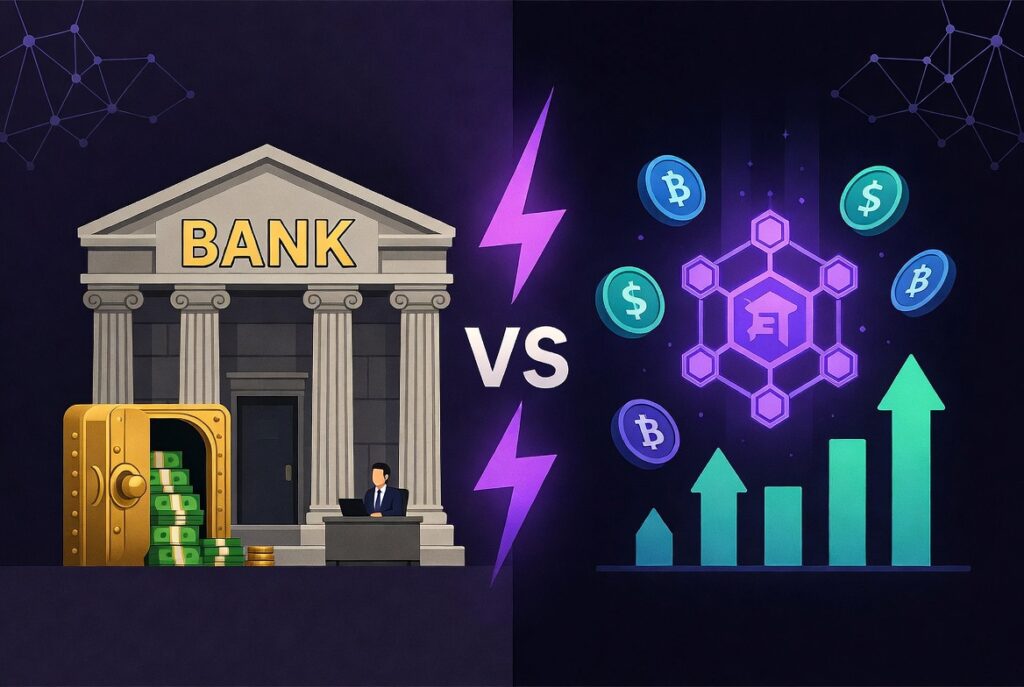
What Is DeFi? A Brief Foundation
Decentralised Finance (DeFi) refers to a set of financial services – DeFi, borrowing, trading, earning interest – that operate through smart contracts on public blockchains, without a central institution managing them.
When you deposit money into a traditional bank, the bank intermediates: it holds your funds, decides who gets loans, sets interest rates, and is legally accountable for doing so. In DeFi, those functions are replaced by code. Protocols like Aave, Compound, and Uniswap execute the same functions – lending, rate-setting, trading – automatically and without a central administrator.
The result is a financial system that is permissionless (anyone with a wallet can access it), transparent (all transactions are publicly visible on-chain), and non-custodial (users retain control of their funds).
DeFi vs Traditional Banking Services: What Each Does
Both systems offer the same core financial services. The delivery mechanism, accessibility, and risk profile differ substantially.
| Service | Traditional Banking | DeFi Equivalent |
|---|---|---|
| Savings / deposits | Savings accounts (0.5-5% APY, insured) | Lending pools – Aave, Compound (2-8% APY, uninsured) |
| Loans | Personal, mortgage, business loans (KYC required) | Over-collateralised loans (no KYC, requires collateral) |
| Payments | Bank transfers, SWIFT, card networks | Stablecoin transfers (USDC, USDT) – minutes, global |
| Trading | Brokerage accounts, stock exchanges | Decentralised exchanges (DEXs) – Uniswap, Curve |
| Insurance | Deposit insurance (FDIC, FSCS) | On-chain insurance protocols (Nexus Mutual, limited) |
| Cross-border transfers | SWIFT (1-5 business days, high fees) | Blockchain transfers (minutes, low fees) |
The differences are not simply cosmetic. They represent fundamentally different relationships between the user and the financial system.
In traditional banking, the institution is the intermediary – it holds your funds, processes your transactions, and is regulated to protect you in the process. In DeFi, smart contracts replace the institution – the code holds the rules, and you interact with it directly.
DeFi vs Traditional Banking Advantages: An Honest Assessment
Advantages of DeFi
1. Accessibility without gatekeeping An estimated 1.4 billion adults worldwide remain unbanked, according to World Bank data. DeFi requires only an internet connection and a wallet to access financial services. No credit score, no identity verification in most cases, no minimum balance. For populations excluded from formal banking, this is genuinely significant.
2. Higher yields on savings Traditional high-yield savings accounts in major markets offer roughly 3.5-5% APY in 2026. DeFi lending platforms on established protocols like Aave and Morpho offer 2-8% on stablecoins, with rates varying based on supply and demand. The advantage has narrowed compared to 2021-2022, but it persists – particularly for users in markets with low domestic savings rates.
3. Full custody and transparency In DeFi, users maintain control of their private keys. Funds are not held by an institution that could freeze accounts, restrict withdrawals, or become insolvent. Every transaction is publicly verifiable on-chain. For users concerned about institutional risk – a concern made concrete by the collapses of Lehman Brothers in 2008 and FTX in 2022 – non-custodial control is a substantive advantage.
4. 24/7 operation DeFi protocols do not close for weekends, public holidays, or maintenance windows. Lending, borrowing, and trading are available continuously, anywhere in the world.
5. Permissionless innovation New financial products in traditional banking require regulatory approval and institutional infrastructure. In DeFi, any developer can deploy a new protocol, creating an environment of rapid, open experimentation. Products like liquid staking, real-world asset tokenisation, and automated yield optimisation emerged from this environment.
Advantages of Traditional Banking
1. Consumer protection and deposit insurance In the United States, FDIC insurance protects deposits up to $250,000 per account holder per institution. Equivalent schemes exist in the EU (up to €100,000), the UK (up to £85,000), and most developed markets. DeFi offers no equivalent protection. A smart contract exploit can result in permanent, unrecoverable loss of funds.
2. Credit without collateral DeFi lending is almost universally over-collateralised – you must deposit more than you borrow. Traditional banks extend unsecured credit based on creditworthiness. A mortgage, a student loan, or a business loan are simply not replicable in current DeFi infrastructure for most borrowers.
3. Legal recourse If a bank makes an error, misappropriates funds, or violates its terms, there are regulatory bodies and legal systems to which consumers can appeal. In DeFi, a bug in a smart contract is typically permanent and unappealable.
4. Fiat integration and everyday usability Paying rent, receiving a salary, and using a debit card all require integration with the traditional financial system. DeFi remains largely disconnected from everyday fiat-denominated life. The on-ramps and off-ramps – exchanging between fiat and crypto – add friction that traditional banking simply does not have.
5. Established trust and familiarity For most people, banking with an established institution is familiar, reliable, and – for everyday needs – completely adequate. The psychological and practical overhead of managing private keys, understanding gas fees, and monitoring protocol risk is a genuine barrier.
DeFi vs Traditional Banking Regulations: The Defining Difference
Regulation is where the gap between the two systems is most stark – and most consequential.
Traditional Banking Regulation
Traditional financial institutions operate within comprehensive regulatory frameworks. In the United States, banks are regulated by the Federal Reserve, the FDIC, the OCC, and state-level authorities. In the EU, the European Central Bank and national regulators apply frameworks including MiFID II and CRD IV. These frameworks impose:
- Capital adequacy requirements
- Anti-money laundering (AML) and Know Your Customer (KYC) obligations
- Consumer protection rules
- Regular audit and stress-testing requirements
- Deposit insurance schemes
The result is a system that is slower and more restrictive, but also more predictable and legally protected for ordinary consumers.
DeFi Regulatory Status
DeFi vs traditional banking regulations is the central unresolved tension in the current financial landscape. DeFi protocols occupy an ambiguous legal position in most jurisdictions.
Key regulatory developments as of early 2026:
- European Union: The Markets in Crypto-Assets (MiCA) regulation, which came into full effect in late 2024, established a licensing framework for crypto-asset service providers. Fully decentralised protocols without an identifiable issuer currently fall outside MiCA’s direct scope, though this is expected to be revisited.
- United States: Regulatory clarity for DeFi remains contested. The SEC and CFTC have taken differing positions on whether DeFi tokens and protocols constitute securities. Stablecoin-specific legislation has progressed in Congress but has not been fully resolved as of the time of writing.
- United Kingdom: The UK’s Financial Conduct Authority (FCA) has extended its crypto financial promotion rules but has not yet produced a comprehensive DeFi framework.
The practical implication for users: DeFi activity exists in a regulatory grey area in most markets. This creates risk on multiple fronts – enforcement action against protocols, tax treatment uncertainty, and limited legal recourse in the event of loss.
Tax treatment is one area where DeFi users face clear obligations regardless of broader regulatory ambiguity. In the US, UK, Australia, and most developed markets, DeFi yield is treated as taxable income when received, and token swaps may constitute taxable disposals. Users should maintain records and consult a qualified tax professional.
The Risk Comparison: Being Honest About Both Sides
Neither system is risk-free. The risks are simply different in nature.
| Risk Type | Traditional Banking | DeFi |
|---|---|---|
| Institutional insolvency | Mitigated by deposit insurance (up to limits) | No equivalent protection |
| Smart contract exploit | Not applicable | Permanent loss possible |
| Regulatory action | Established appeals process | Uncertain; limited recourse |
| Inflation / purchasing power | Shared risk | Shared risk |
| Account freezing | Possible (regulatory, error) | Not possible (self-custody) |
| Phishing / fraud | Bank fraud protections apply | User solely responsible |
| Counterparty default | Regulated capital requirements provide buffer | Over-collateralisation provides buffer |
The common thread in DeFi risk is user responsibility. When things go wrong in DeFi – and they do, with regularity across the broader ecosystem – there is no complaints line, no regulatory body, and no insurance fund. In traditional banking, institutional failure is far rarer and carries substantially more protection.
Can DeFi and Traditional Banking Coexist?
The most likely outcome is not replacement but integration. Several developments point in this direction:
- Major banks including JPMorgan, Goldman Sachs, and BNY Mellon have begun tokenising real-world assets on blockchain infrastructure.
- BlackRock’s BUIDL fund, launched in 2024, tokenised US Treasury securities on Ethereum, bringing institutional fixed income into DeFi rails.
- Central bank digital currencies (CBDCs) are in development in over 130 countries, representing a state-backed form of digital money that may eventually bridge fiat and blockchain systems.
- Regulated DeFi – protocols that incorporate compliance layers while retaining smart contract execution – is an emerging category that may satisfy both user demand for transparency and regulatory requirements.
The financial system of 2030 will likely incorporate elements of both – blockchain infrastructure for settlement efficiency and transparency, combined with regulatory frameworks that provide consumer protection.
Summary: Which Is Right for You?
| If you value… | Consider… |
|---|---|
| Deposit protection and legal recourse | Traditional banking |
| Higher yields on stablecoin savings | DeFi lending (with appropriate caution) |
| Self-custody and no gatekeeping | DeFi |
| Credit without collateral | Traditional banking |
| 24/7 global access | DeFi |
| Simplicity and familiarity | Traditional banking |
| Transparency and auditability | DeFi |
| Everyday fiat integration | Traditional banking |
For most people, the answer is not either-or. A practical approach is to use traditional banking for everyday financial life – salary, rent, savings with insurance protection – while exploring DeFi selectively for portions of savings where the yield advantage justifies the additional complexity and risk.
Final Thoughts
The DeFi vs traditional banking conversation is not about which system wins. It is about understanding what each system does well, who it serves, and what risks it asks you to accept. Traditional banking provides protection and familiarity at the cost of access and yield. DeFi provides transparency and control at the cost of safety nets and simplicity.
For anyone navigating this landscape, the most important thing is to understand both systems before committing meaningful capital to either – or to the growing number of products that sit between them.
Disclaimer: This article is for educational purposes only and does not constitute financial or legal advice. Regulatory environments are evolving rapidly; always verify the current status of DeFi regulation in your jurisdiction. Consult a qualified financial adviser before making significant financial decisions.

 DefinedFi